Why Decentralized Storage Keeps Failing
Decentralized storage (e.g. Filecoin) and data availability networks (e.g. Celestia) emerged to solve real problems around permanence, censorship resistance, and verifiability. In those domains, they succeeded.

Jan 19, 2026
Decentralized storage (e.g. Filecoin) and data availability networks (e.g. Celestia) emerged to solve real problems around permanence, censorship resistance, and verifiability. In those domains, they succeeded. However, they failed in replacing centralized cloud infrastructure for the majority of modern applications. The reason is not ideological, but architectural: they optimized for the wrong kind of data.
Cold Data vs. Hot Data

Most decentralized storage networks were designed around cold data. Data that is written once, accessed infrequently, and valued primarily for its permanence. This model works well for archival records, NFT metadata, historical blockchain data, and auditability.
Modern applications however, are dominated by hot data. Data that is constantly changing, frequently accessed and highly sensitive to latency and throughput. Centralized clouds did not win simply because they are centralized. They won because they are fast, predictable, and operationally simple.
Decentralized storage guaranteed existence, but applications required usability.
Availability Is Not Usability
Data availability layers correctly identified a scaling bottleneck for blockchains. Ensuring that data exists and can be verified is a necessary condition, but it is not sufficient for application development.
Availability alone does not provide:
Low latency reads and writes
Indexing and querying
Real time access patterns
Application level composability
As a result, these systems became infrastructure for chains, not for applications. They did not replace cloud backends, nor did they remove off chain dependencies.
Developer Experience and Operational Friction
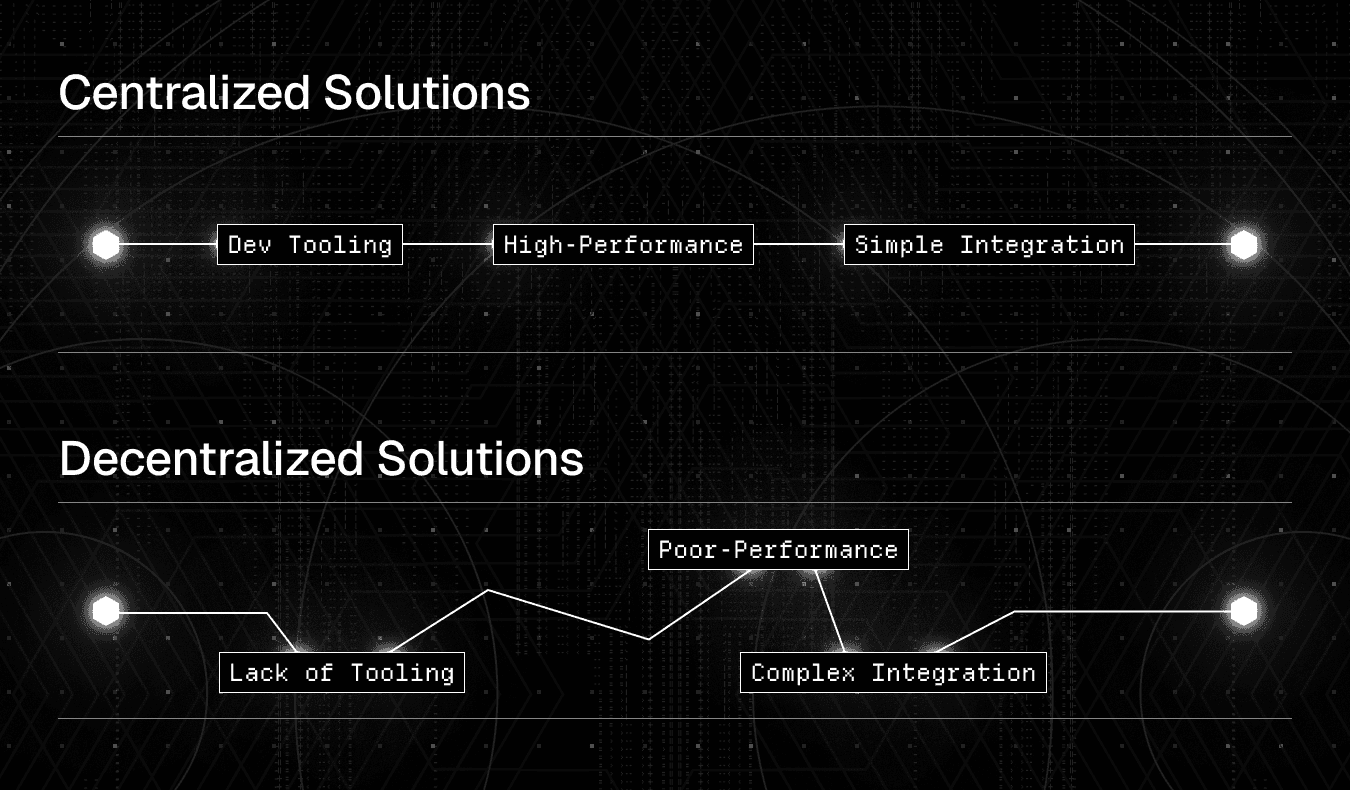
Even when decentralized systems worked as designed, they introduced meaningful friction for builders. New tooling, unfamiliar operational models, and unpredictable performance made production and deployment difficult. Developers building real products are optimizing for reliability, speed, and time to market.
When forced to choose, most teams default to centralized clouds. Not because of ideology, but because of pragmatism.
Infrastructure that slows builders down does not get adopted.
Missing Economic Alignment
Most decentralized storage networks focused on miner or operator incentives, not on ecosystem or application economics. Storage fees functioned purely as a cost. There was no meaningful mechanism to:
Route fees back to the host ecosystem
Reward data originators
Unlock the inherent value in the data itself
Even when applications used decentralized storage, value still flowed outward. No native economic flywheel emerged around data.
Data Remained Isolated
Finally, decentralization did not solve data silos. Although application still controlled its own datasets, data was not permissionlessly composable. In other words, other builders couldn’t easily extend or build on top of existing data.
Decentralized storage was a market, not an economy.
Did decentralized storage fail?
Decentralized storage networks changed where data lived, but not how data lived. They solved:
Permanence, not performance.
Availability, not usability.
Infrastructure, not economic flow.
The takeaway is not that decentralized storage failed outright. It is that data is treated as static files rather than productive capital, and centralized storages with an economically extractive nature have been progressively normalized.
This enlarges the gap highlighted in the Hot Data Manifesto and the gap modern data infrastructure must close for data to become a true economic primitive.
Disclaimer:
This content is provided for informational and educational purposes only and does not constitute legal, business, investment, financial, or tax advice. You should consult your own advisers regarding those matters.
References to any protocols, projects, or digital assets are for illustrative purposes only and do not represent any recommendation or offer to buy, sell, or participate in any activity involving digital assets or financial products. This material should not be relied upon as the basis for any investment or network participation decision.
Hyve and its contributors make no representations or warranties, express or implied, regarding the accuracy, completeness, or reliability of the information provided. Digital assets and decentralized networks operate within evolving legal and regulatory environments; such risks are not addressed in this content.
All views and opinions expressed are those of the authors as of the date of publication and are subject to change without notice.