New Year, Same Issue

Despite advances in decentralized execution and settlement, a core limitation remains: data. As the Hot Data Manifesto notes, Web3 freed money and compute, but data stayed locked in centralized silos, limiting truly decentralized economies.

Despite major advances in the decentralizing of execution and settlement, one of the inherent limitations in both Web2 and Web3 continues to be the data itself. As pointed out in the Hot Data Manifesto, Web3 succeeded in freeing money and compute, but data remained trapped in centralized silos, preventing it from becoming the engine that would power thriving decentralized economies.

This isolation manifests itself in two distinct ways that limit innovation and economic opportunity: data isolation (the inability for data to be permissionlessly reused or composed) and economic leakage (the ongoing export of value to centralized storage providers). Together, they undermine the promise of decentralization at the layer where information and value intersect.

Data Isolation

(Structural: lack of composability and reuse)

Data generated by protocols and applications today is typically locked within proprietary or centralized systems. While blockchain execution and settlement happen on shared, decentralized infrastructure, the actual data, including data that describes state and behavior often sits behind APIs or in cloud storage that cannot be easily or permissionlessly composed by other builders. This means that even when data is technically public, it does not function as a shared economic primitive.

In practice, this leads to:

  • Redundant rebuilding of context for each new application

  • Protocols unable to build on one another’s data

  • A lack of shared data primitives extending across ecosystems

Data exists, but it is siloed, fragmented and non-compounding, becoming a roadblock to innovation.
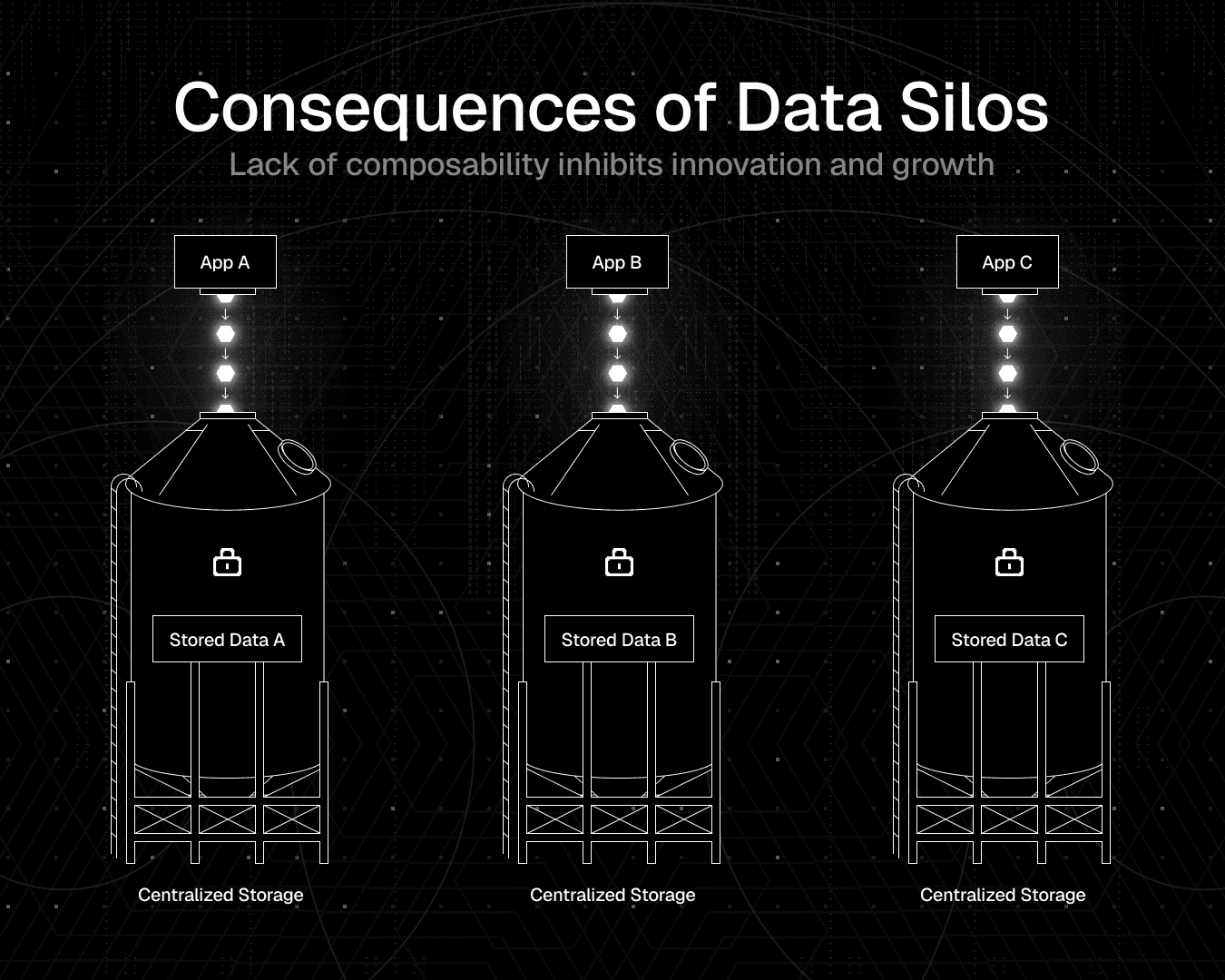
Composable liquidity, compute and execution has matured Web3, however static, confined data stifles the emergence of a true “decentralized data fabric.” 

Economic Leakage

(Economic: off-chain extraction via centralized storage)

Many decentralized protocols rely on centralized cloud providers such as AWS S3, Google Cloud, or Azure to handle high-throughput, low-latency storage and egress. While these services are functionally reliable, the fees they accrue are paid off-chain and flow to corporations outside the ecosystem.

The consequences are:

  • Data fees are paid in fiat and extracted from the ecosystem’s economic loop

  • Validators, operators, and native token holders receive none of this value

  • Data infrastructure becomes a permanent net cost, not a shared asset

Instead of reinforcing the economic flywheel of the ecosystem, data costs are exported to external monopolies that do not contribute to network security or growth.

On-chain activity increasingly finances off-chain extraction.
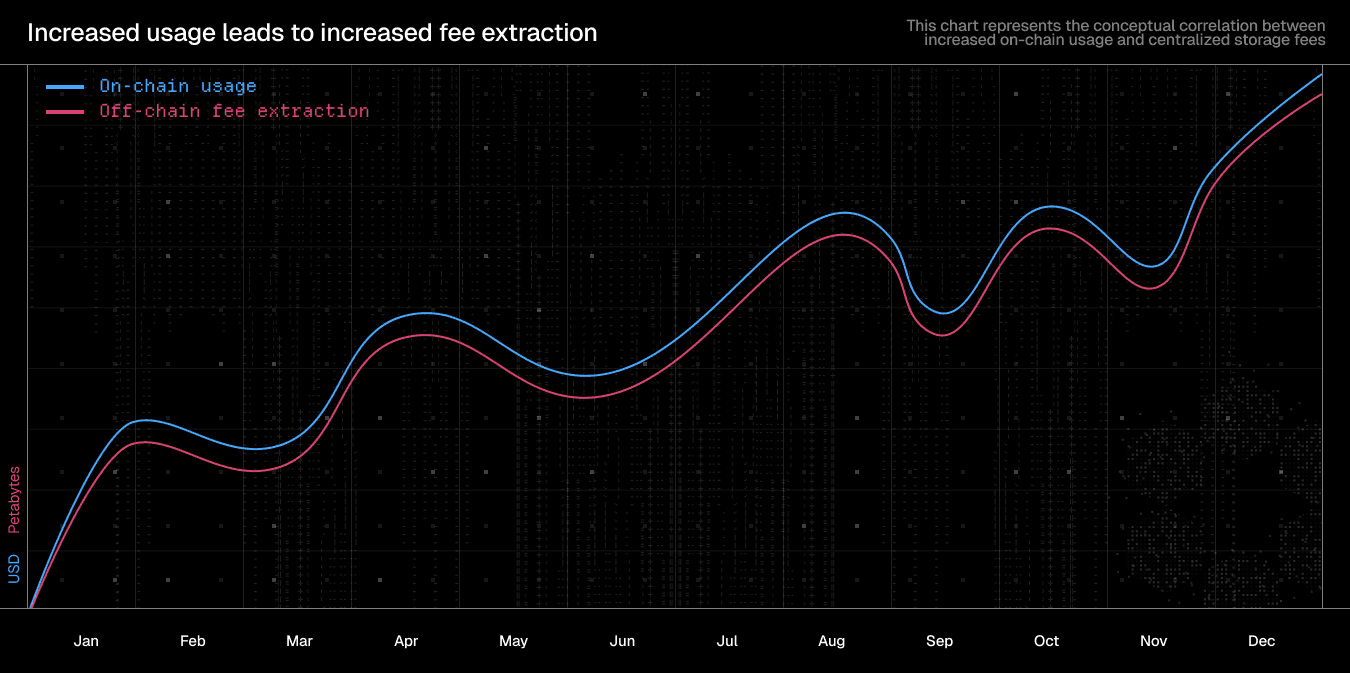
The more value a network generates, the more it loses to external systems.This economic leakage directly contradicts the decentralized ethos.

Data is not (yet) a primitive

Because of data isolation and a hefty economic leakage, data has never been treated by protocols as an economic primitive. Data cannot be:

  • Permissionlessly reused or extended

  • Composed into new, value-creating applications

  • Monetized by the communities that generate it

  • Reinvested into the native ecosystem that produced it

Decentralized data alternatives do exist, yet they fail to accomplish the heavy lifting required by a true on-chain data economy. Simply decentralizing data is not enough to satisfy the future demands of Web3. For data to achieve the utility enjoyed by liquidity and compute in Web3, it needs to become composable and it needs to become economically native. 

Disclaimer:

This content is provided for informational and educational purposes only and does not constitute legal, business, investment, financial, or tax advice. You should consult your own advisers regarding those matters.

References to any protocols, projects, or digital assets are for illustrative purposes only and do not represent any recommendation or offer to buy, sell, or participate in any activity involving digital assets or financial products. This material should not be relied upon as the basis for any investment or network participation decision.

Hyve and its contributors make no representations or warranties, express or implied, regarding the accuracy, completeness, or reliability of the information provided. Digital assets and decentralized networks operate within evolving legal and regulatory environments; such risks are not addressed in this content.

All views and opinions expressed are those of the authors as of the date of publication and are subject to change without notice.


Related Posts

Sep 20, 2025

Crypto is obsessed with decentralization. On the other hand, crypto leans hard on Amazon’s AWS S3 (Amazon’s Super Simple Storage) and other popular centralized storages for its data needs. What do we mean by data needs?

Sep 2, 2025

Throughput, latency and fees. Everyone is obsessed with these. But history doesn’t lie. Performance doesn’t win. Tooling does. The difference between projects that fade and those that define their category comes down to tooling.

Aug 9, 2025

Hyve is a decentralized data storage with competing qualities to those of AWS S3. It also boasts a robust DA (Data Availability) solution, which exists as a cog in the greater data infrastructure engine that Hyve encompasses.

Aug 2, 2025

Whether your app lives on a L1, L2, or L3, its value comes from the security, decentralization, and economics of the base layer it relies on. However, most apps break this alignment when they rely on centralized cloud providers such as AWS S3.

Sep 20, 2025

Crypto is obsessed with decentralization. On the other hand, crypto leans hard on Amazon’s AWS S3 (Amazon’s Super Simple Storage) and other popular centralized storages for its data needs. What do we mean by data needs?

Sep 2, 2025

Throughput, latency and fees. Everyone is obsessed with these. But history doesn’t lie. Performance doesn’t win. Tooling does. The difference between projects that fade and those that define their category comes down to tooling.

Nov 2, 2025

On October 20, 2025, many awoke to a digital landscape in disarray. What began as a routine morning quickly devolved into a widespread disruption: Reddit was inaccessible, Snapchat wouldn't load, Zoom and Microsoft Teams meetings failed to connect.

Oct 20, 2025

On October 20, 2025, many awoke to a digital landscape in disarray. What began as a routine morning quickly devolved into a widespread disruption: Reddit was inaccessible, Snapchat wouldn't load, Zoom and Microsoft Teams meetings failed to connect.

Sep 20, 2025

Crypto is obsessed with decentralization. On the other hand, crypto leans hard on Amazon’s AWS S3 (Amazon’s Super Simple Storage) and other popular centralized storages for its data needs. What do we mean by data needs?

Sep 2, 2025

Throughput, latency and fees. Everyone is obsessed with these. But history doesn’t lie. Performance doesn’t win. Tooling does. The difference between projects that fade and those that define their category comes down to tooling.

Aug 9, 2025

Hyve is a decentralized data storage with competing qualities to those of AWS S3. It also boasts a robust DA (Data Availability) solution, which exists as a cog in the greater data infrastructure engine that Hyve encompasses.

Aug 2, 2025

Whether your app lives on a L1, L2, or L3, its value comes from the security, decentralization, and economics of the base layer it relies on. However, most apps break this alignment when they rely on centralized cloud providers such as AWS S3.

Sep 20, 2025

Crypto is obsessed with decentralization. On the other hand, crypto leans hard on Amazon’s AWS S3 (Amazon’s Super Simple Storage) and other popular centralized storages for its data needs. What do we mean by data needs?

Sep 20, 2025

Crypto is obsessed with decentralization. On the other hand, crypto leans hard on Amazon’s AWS S3 (Amazon’s Super Simple Storage) and other popular centralized storages for its data needs. What do we mean by data needs?

Sep 2, 2025

Throughput, latency and fees. Everyone is obsessed with these. But history doesn’t lie. Performance doesn’t win. Tooling does. The difference between projects that fade and those that define their category comes down to tooling.

Sep 2, 2025

Throughput, latency and fees. Everyone is obsessed with these. But history doesn’t lie. Performance doesn’t win. Tooling does. The difference between projects that fade and those that define their category comes down to tooling.

Aug 9, 2025

Hyve is a decentralized data storage with competing qualities to those of AWS S3. It also boasts a robust DA (Data Availability) solution, which exists as a cog in the greater data infrastructure engine that Hyve encompasses.

Aug 9, 2025

Hyve is a decentralized data storage with competing qualities to those of AWS S3. It also boasts a robust DA (Data Availability) solution, which exists as a cog in the greater data infrastructure engine that Hyve encompasses.

Aug 2, 2025

Whether your app lives on a L1, L2, or L3, its value comes from the security, decentralization, and economics of the base layer it relies on. However, most apps break this alignment when they rely on centralized cloud providers such as AWS S3.

Aug 2, 2025

Whether your app lives on a L1, L2, or L3, its value comes from the security, decentralization, and economics of the base layer it relies on. However, most apps break this alignment when they rely on centralized cloud providers such as AWS S3.

Sep 20, 2025

Crypto is obsessed with decentralization. On the other hand, crypto leans hard on Amazon’s AWS S3 (Amazon’s Super Simple Storage) and other popular centralized storages for its data needs. What do we mean by data needs?

Sep 2, 2025

Throughput, latency and fees. Everyone is obsessed with these. But history doesn’t lie. Performance doesn’t win. Tooling does. The difference between projects that fade and those that define their category comes down to tooling.

Aug 9, 2025

Hyve is a decentralized data storage with competing qualities to those of AWS S3. It also boasts a robust DA (Data Availability) solution, which exists as a cog in the greater data infrastructure engine that Hyve encompasses.