Developer Update #1
Welcome to the inaugural edition of Hyve's Developer Updates! These periodic updates will summarize the last development cycles of the Hyve protocol and its results. Over the last year, the devs have...
Jan 20, 2026
Welcome to the inaugural Hyve protocol updates! These periodic updates will summarize the last development cycles of the Hyve protocol and its results.
Over the last year, the devs have been cooking on several parts of the system:
The overall network architecture
Optimizing the read and write path
Implementing a custom storage engine
Network consensus, slashing, staking, and rewards
Optimizing the erasure coding module
Enabling verification
Testing data durability guarantees
And many more items
Today we will be diving into our latest advancements in erasure coding and the overall network architecture, leaving deeper walk-throughs for subsequent developer updates.
What we are building
Hyve is a real-time storage layer that turns data into an economic primitive.
We're building infrastructure for data that needs to be fast, verifiable, and owned; not rented from centralized providers. Trust assumptions and vendor lock-in from traditional cloud storage have been outgrown by RWAs, AI, CLOBs, DePIN and other decentralized real-time applications. Yet latency, throughput, and costs remain an ever-growing penalty of existing decentralized alternatives.
Hyve was born to change this.
What we built.
Hyve Erasure
Data availability is one of the hardest problems to solve at scale. Replication is costly, brittle under churn and inefficient as throughput grows. We needed availability guarantees that remain fast, verifiable and decentralized as the network expands.
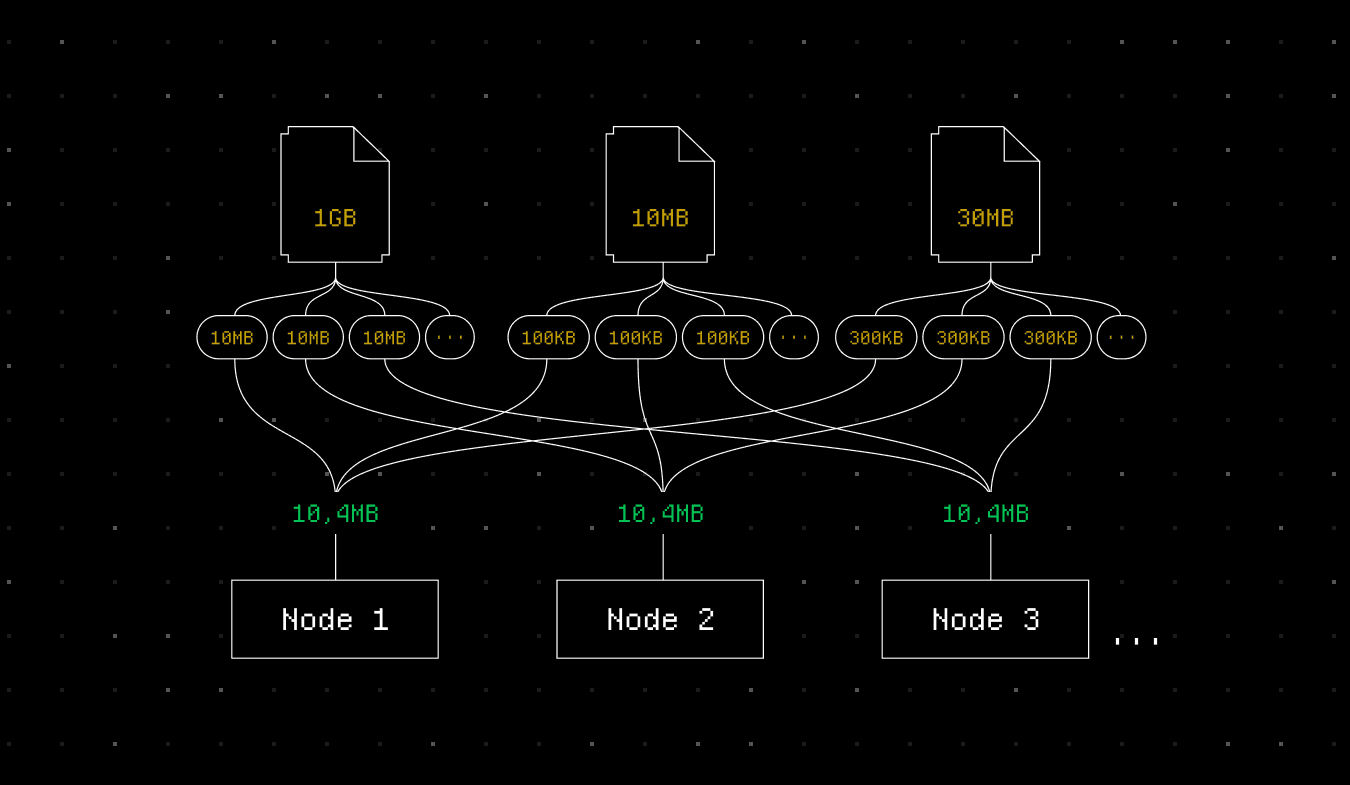
Erasure coding is the answer: encoding blobs into redundant shards that can be recovered from any sufficient subset. Availability emerges from the network instead of a single provider. However, proving that shards are validly derived from the original blob typically requires polynomial commitments like KZG, which carry significant latency and compute costs.
Our scheme is built on Hadamard ZODA-style erasure coding, giving us properties especially well-suited for decentralized networks:
Structured encoding that enables fast, predictable recovery
Efficient verification without KZG overhead
Network-friendly redundancy optimized for distribution
Critically, our adaptation of Hadamard ZODA allows us to encode, verify and ingest blobs completely in parallel, without requiring a central encoder for all incoming blobs. This removes the sequencer-and-mempool bottleneck found in most DA architectures.
Benchmarks are coming in Update #2. We've prioritized correctness over performance measurement so far, but encoding speed, recovery time, and overhead ratios will follow.
Network Architecture
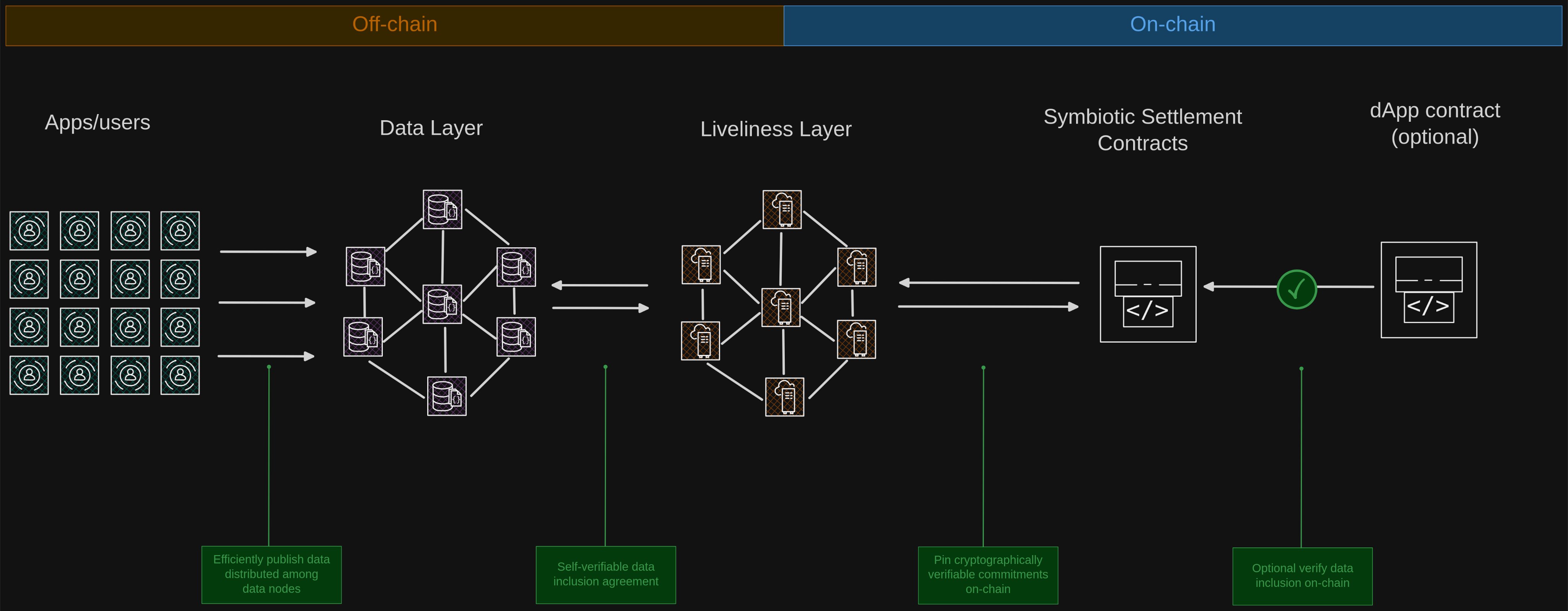
We've defined the core topology that will run Hyve. This required R&D into network designs, consensus mechanisms, and data availability guarantees. We landed on a three-layer architecture:
Settlement Layer Hyve anchors to an existing network, starting with Ethereum, to settle network state and handle (security) execution via smart contracts. Hyve itself has no execution layer; we inherit it entirely from settlement.
Data Layer We concluded early that data should move as little as possible for consensus purposes. The network that maintains data must be essentially "dumb." The data layer consists of an unbounded set of nodes that receive data from clients, validate it, store it, and announce only pointers. Data itself only moves between nodes during reconstruction or sampling.
Metadata Layer A bounded set of permissionless nodes that maintain metadata for available blobs. They run an operational consensus mechanism and post certificates to the settlement layer.
Gateway (Virtual Layer) The data ecosystem has massive tooling gravity. Rather than fight it, Hyve exposes a virtual layer that adapts to S3, LanceDB, DuckDB, Bufstream, PyTorch, and other data tools, making integration seamless for web2 and onchain developers alike. The gateway also ensures stateless reads and writes: no complex RPC setup required to start using Hyve.
What’s next
In the next update we will dive deeper into the read and write paths to explore how blobs move from user submission to the distributed storage layer in record speeds. Additionally, we will dive into the security side of things and our integration with Symbiotic.
Questions? We'll address them in a Q&A section in Update #2.
Disclaimer:
This content is provided for informational and educational purposes only and does not constitute legal, business, investment, financial, or tax advice. You should consult your own advisers regarding those matters.
References to any protocols, projects, or digital assets are for illustrative purposes only and do not represent any recommendation or offer to buy, sell, or participate in any activity involving digital assets or financial products. This material should not be relied upon as the basis for any investment or network participation decision.
Hyve and its contributors make no representations or warranties, express or implied, regarding the accuracy, completeness, or reliability of the information provided. Digital assets and decentralized networks operate within evolving legal and regulatory environments; such risks are not addressed in this content.
All views and opinions expressed are those of the authors as of the date of publication and are subject to change without notice.