Arbitrum to Enable Data Economy with Hyve
We’re thrilled to announce Hyve’s integration with Arbitrum, beginning on Hyve’s private devnet, to explore a shared, real-time data layer for the Arbitrum ecosystem.

Feb 11, 2026
We’re thrilled to announce Hyve’s integration with Arbitrum, beginning on Hyve’s private devnet, to explore a shared, real-time data layer for the Arbitrum ecosystem.
Arbitrum has become a leading execution layer for DeFi, home to some of the most innovative products and deepest liquidity in the ecosystem. On the other hand, cloud storage was designed for a world where compute runs next to storage, in the same vendor and region. That assumption is breaking.
The next wave of applications in RWAs, AI, DeFi, and consumer don't run on blockspace alone: they rely on real-time offchain state and data. Today, that data lives in siloed cloud storage and private pipelines, so every application rebuilds the same infrastructure from scratch. Datasets stay locked inside each app, and keeping them fast and reliable is handled offchain in fragmented, ad-hoc ways. Hyve is designed to make that real-time data globally available, verifiable, composable, and economically aligned to Arbitrum.
Arbitrum is Hyve’s first early adopter chosen for its performance and its role at the center of DeFi, to explore how shared real-time data infrastructure can support the next phase of onchain applications.
Why this matters now
Arbitrum is a place where composability at the smart contract level is the default. But as DeFi expands into perpetuals, lending markets, onchain risk engines, RWAs, and AI-native applications, data becomes the primary bottleneck instead of execution.
Smart contracts are composable within Arbitrum by default. Data is not. And that gap increasingly determines which project scales and which ones get stuck rebuilding the foundation.
In practice, onchain applications are now shaped by three factors:
1) Low latency data access
Real-time state is foundational to any user experience and it's no different in consumer and DeFi applications. Today, real-time capabilities are mostly delivered through centralizing parts of the stack. That works, until it doesn’t. It introduces hidden operational risks of outages, inconsistent reads, and privileged access.
2) Verifiability is your competitive advantage
As Vitalik argues, we’re putting more and more trust into tech. When there is even a whiff of that trust breaking, systems revert to exclusionary models: “was this built by people I trust?”.
DeFi is exactly that environment. Many parties are participating with capital at stake in an environment where nobody trusts each other. If the state of your protocol depends on is opaque or controlled by a single vendor, these parties inherit a trust problem. For any high-value system, trust problems become risk premiums.
3) Data fragmentation is an economic tax on the ecosystem
When each protocol builds its own offchain data stack in isolation, data stops being a shared primitive and becomes a repeated overhead that leads to higher burn and slower iteration.
At the same time, offchain data in onchain systems is treated as purely an operational cost while it should be treated as an opportunity. When data is siloed and fragmented, it can’t become a shared primitive; there’s no protocol-native way for that usage to strengthen the ecosystem. In other words: the ecosystem pays again and again to the big cloud for the same capabilities but the resulting state can’t be composed across apps, so network effects don’t compound.
What This Will Unlock
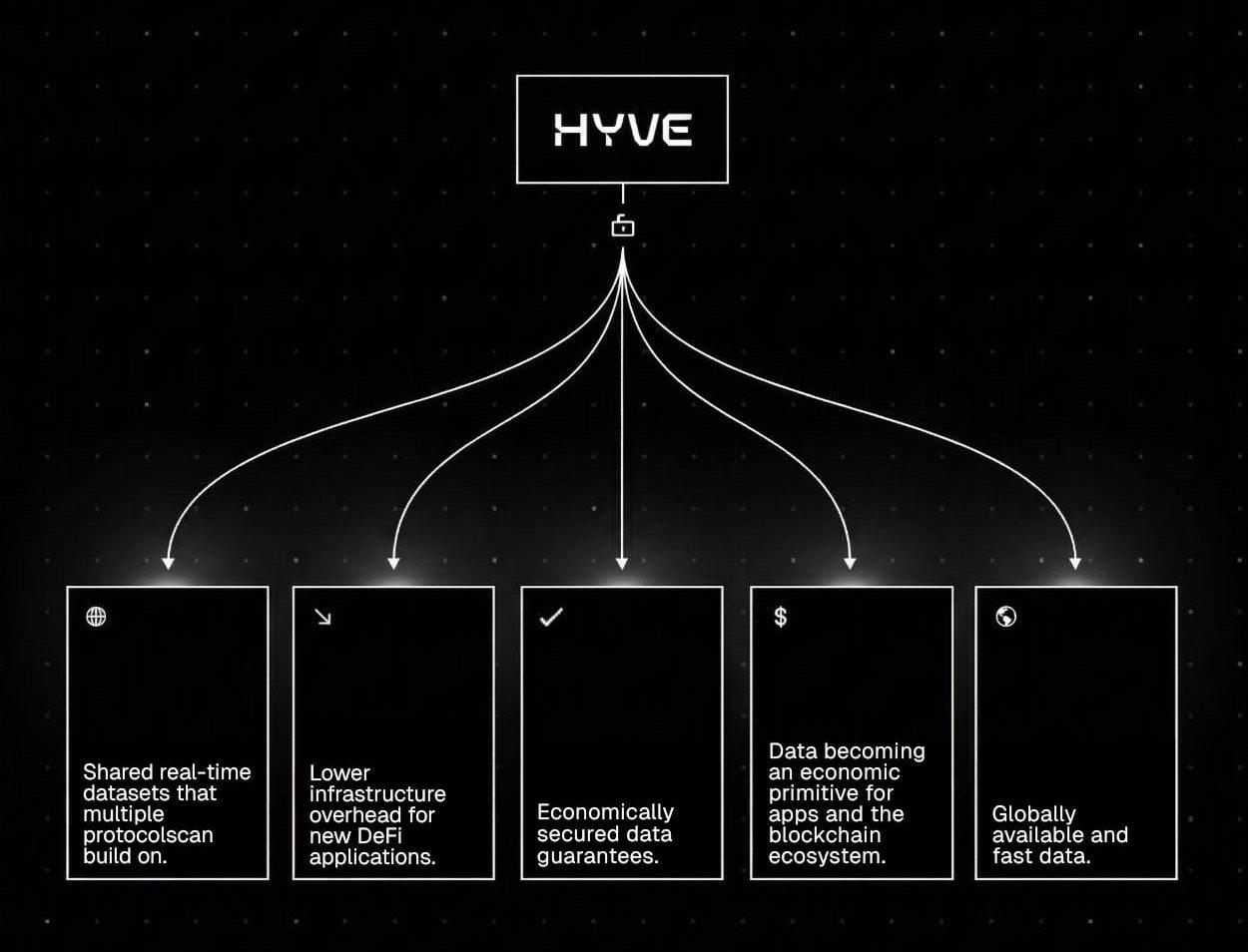
By introducing a shared real-time data layer on Arbitrum, Hyve is expanding the design space for builders and researchers working on DeFi, RWAs, AI, and consumer facing applications. Potential outcomes under exploration include:
Shared real-time datasets that multiple protocols can build on
Lower infrastructure overhead for new applications
Economically secured data guarantees and data sovereignty
Data evolving into an economic primitive for applications and the broader ecosystem
Globally available and fast data
These concepts are especially relevant for protocols such as perpetuals, lending markets, and on-chain risk engines, where real-time data is foundational to system design.
Arbitrum as an Early Contributor
Arbitrum’s role in this infrastructure goes beyond adoption. As an early adopter, the Arbitrum ecosystem is helping shape how real-time, permissionless data could operate within a production DeFi environment. Areas of exploration include:
Data economies and how data infrastructure could remain aligned with Arbitrum and its applications’ long-term value capture
Data royalties as a potential mechanism for strengthening ecosystem resilience
Economic alignment among data producers, consumers, and the network itself
Accelerated innovation enabled by shared, composable data primitives
This work reflects Arbitrum’s broader approach to scaling the ecosystem thoughtfully, focusing not only on execution and liquidity, but also on how foundational layers interact.
What Comes Next
This integration represents an early step toward rethinking how data fits into high-performance blockchain ecosystems. The next milestone to be achieved is Hyve’s public testnet. This will allow our system to be properly tested under load and at scale, a great opportunity for fine tuning and increasing efficiency, and an opportunity to receive valuable feedback from our integrators in the Arbitrum ecosystem before moving on to Testnet. Simultaneously, we will be proving our software, sharing metrics and giving real-world comparisons to popular centralized solutions.
Arbitrum’s data economy is coming.
Disclaimer:
This content is provided for informational and educational purposes only and does not constitute legal, business, investment, financial, or tax advice. You should consult your own advisers regarding those matters.
References to any protocols, projects, or digital assets are for illustrative purposes only and do not represent any recommendation or offer to buy, sell, or participate in any activity involving digital assets or financial products. This material should not be relied upon as the basis for any investment or network participation decision.
Hyve and its contributors make no representations or warranties, express or implied, regarding the accuracy, completeness, or reliability of the information provided. Digital assets and decentralized networks operate within evolving legal and regulatory environments; such risks are not addressed in this content.
All views and opinions expressed are those of the authors as of the date of publication and are subject to change without notice.